A. Making a solar still
We cannot survive without water, because water is an essential element in our body. If you are running out of fresh water and there are no other sources of water on the deserted island, you have to desalinate or distill seawater using some simple tools. For instance, you can make a solar still.
Materials:
- One plastic bottle of seawater
- One empty plastic bottle
- One plastic sheet
- A few large rocks
- One small rock
Steps:
- A hole is dug deep in the sand.
- An empty plastic bottle is placed in the centre of the hole.
- A plastic bottle with seawater next to the empty bottle.
- A plastic sheet is placed over the hole and anchored in place with large rocks around the edges of the hole.
- A small rock is placed in the centre of the sheet over the empty bottle.
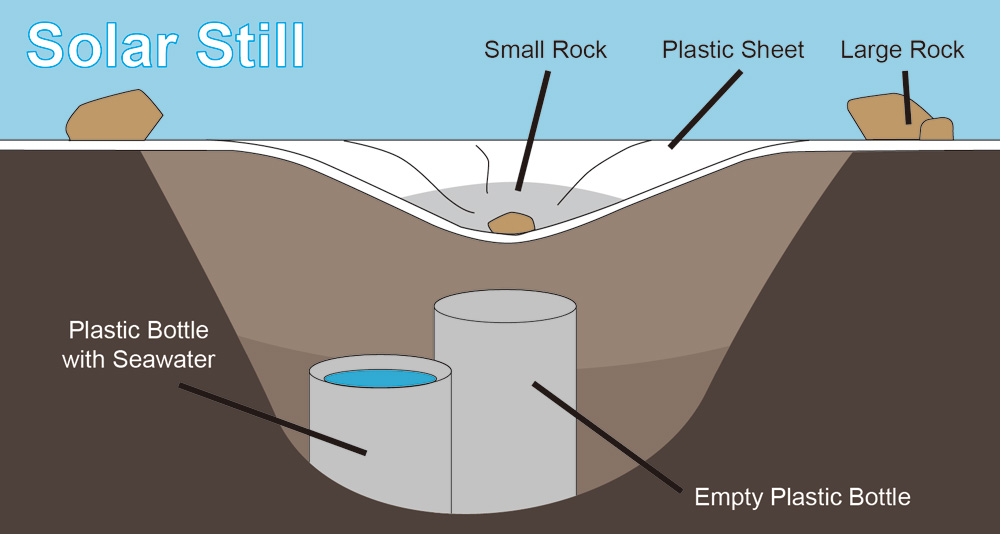
Schematic Diagram of the Experimental Setup
B. Discussion
- How efficient is this solar still? Try to design an experiment to test its efficiency.
- How can you increase the efficiency of this solar still? (e.g. Cutting the empty plastic bottle in half for a large surface area of water being exposed to sunlight)
- Someone uses two plastic bottles, one large and the other small, to make a simpler solar still. Can you think of its design and how it works?
- Can you think of a better design? sketch the designs of your own solar still. Try to think of some necessary considerations when designing the solar still. (e.g. the diameter, height and size of container and other materials used)
A. Sustainable Community around a Water Reclamation Plant
It may be a good idea to create a sustainable community around a water reclamation plant where adjacent industries and facilities can be benefited from the plant. Efficient and effective use of land, recycled water and other resources can then be achieved.
-
With the use of a mind map, list the industries and facilities that can be benefited from the water reclamation plant.

- List all other resources that those industries and facilities require other than recycled water.
- Design and draw a map of a sustainable community where those industries and facilities are built around the water reclamation plant, together with other necessary facilities.
- Explain to others how the community is designed, how the industries and facilities in the community are interrelated, and how they are benefited from water reclamation.