Milestones of Water Supply in 1851 - 1902
1851
First Wells Dug for Public Water Supply
In 1851, the Government set aside in its budget for sinking wells to provide water to the public for free. In the period before 1860, the Government also constructed small ponds at the upper parts of main streams to store water for public use.
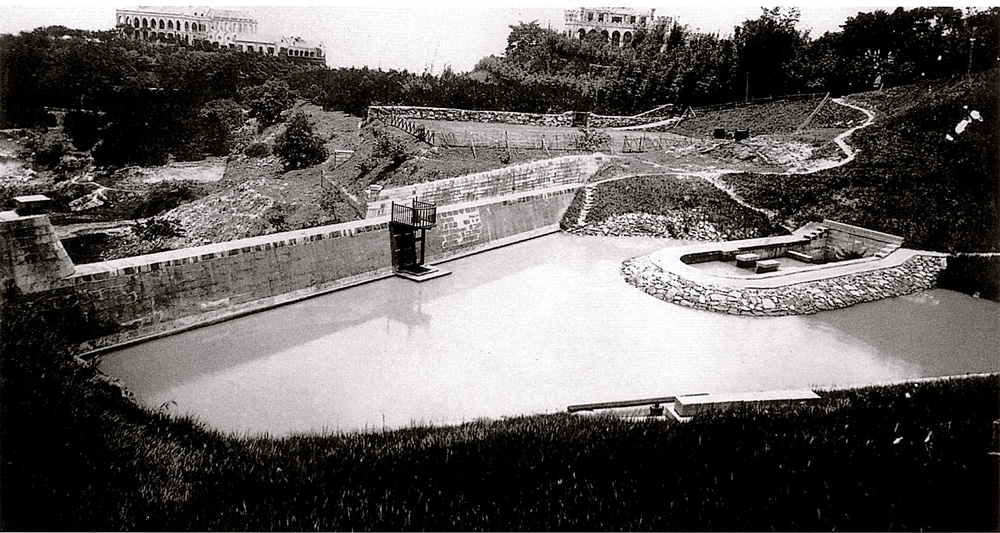
Pok Fu Lam Reservoir in 1860s
1863
Hong Kong’s First Impounding Reservoir: Pok Fu Lam Reservoir
Between 1841 and 1861, the population increased by over ten-fold from 7,000 to 120,000. Most of the people resided in the north-western part of Hong Kong Island. There was a strong demand for water. To cope with the rapid population growth, the Government needed to develop water resources.
In 1859, the Government announced an award of 1,000 dollars to anyone who could produce a viable proposal for water supply. The award winner, S.B. Rawling, a Clerk of Works in the British Royal Engineering Department, proposed to construct a reservoir in the Pok Fu Lam valley. Construction work commenced in 1860 and the reservoir started to supply water by the end of 1863. With a capacity of only 2 million gallons (9,100 m3), the system soon needed to be expanded. The extension of reservoir completed in 1877 boosted the overall capacity to 68 million gallons (310,000 m3), drawing from a water catchment that covered 416 acres (168 hectares). The Pok Fu Lam Reservoir we see today is still making contribution to Hong Kong’s water supply.
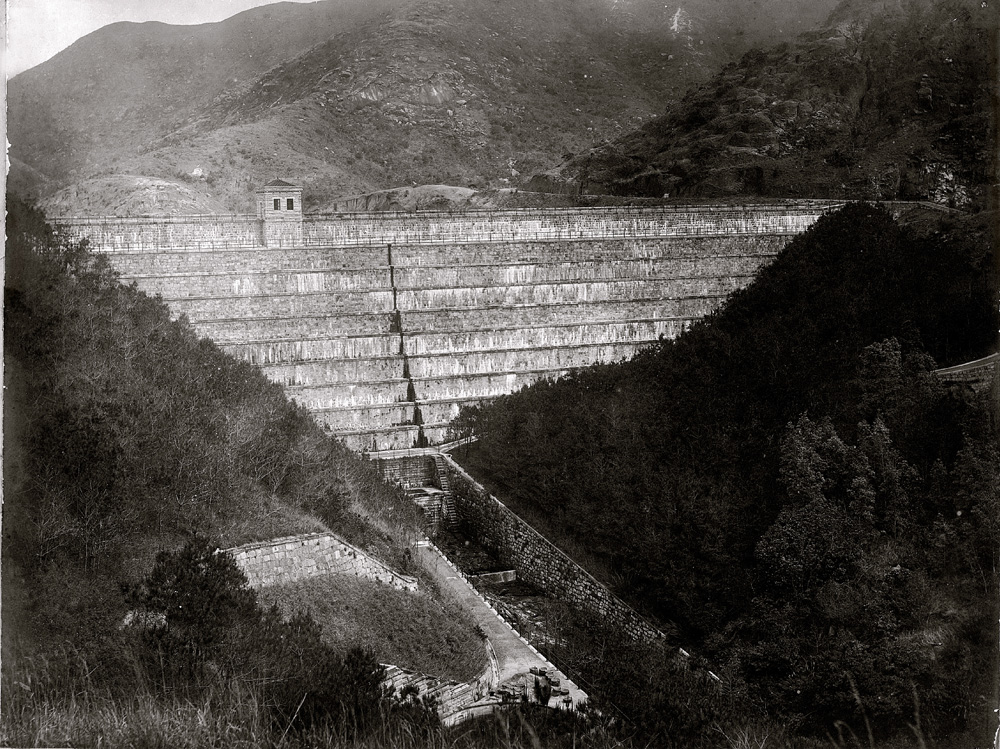
Tai Tam Reservoir dam some 20 years after completion
1883
The Launch of Tai Tam Valley Scheme
The Pok Fu Lam Reservoir was too small in capacity to cater for the needs of Hong Kong’s increasing population. The Government embarked upon the construction of the Tai Tam Reservoir. The Tai Tam Valley Scheme, as the reservoir project was called, included the building of filter beds at Albany Valley (today’s upper reach of Cotton Tree Drive). This was the first time that filtered water was supplied in Hong Kong.
The Tai Tam Reservoir was a gigantic project for its time. It was constructed between 1883 and 1888. The Tai Tam Reservoir had a storage capacity of 250 million gallons (1.14 million m3) which was almost four times the size of the Pok Fu Lam Reservoir.
The Tai Tam Valley Scheme was completed and expanded to become the Tai Tam Upper Reservoir we see today. It could hold 388 million gallons (1.76 million m3) of water. It supplied areas of the present day Central, Wan Chai, Causeway Bay, North Point and Shau Kei Wan.
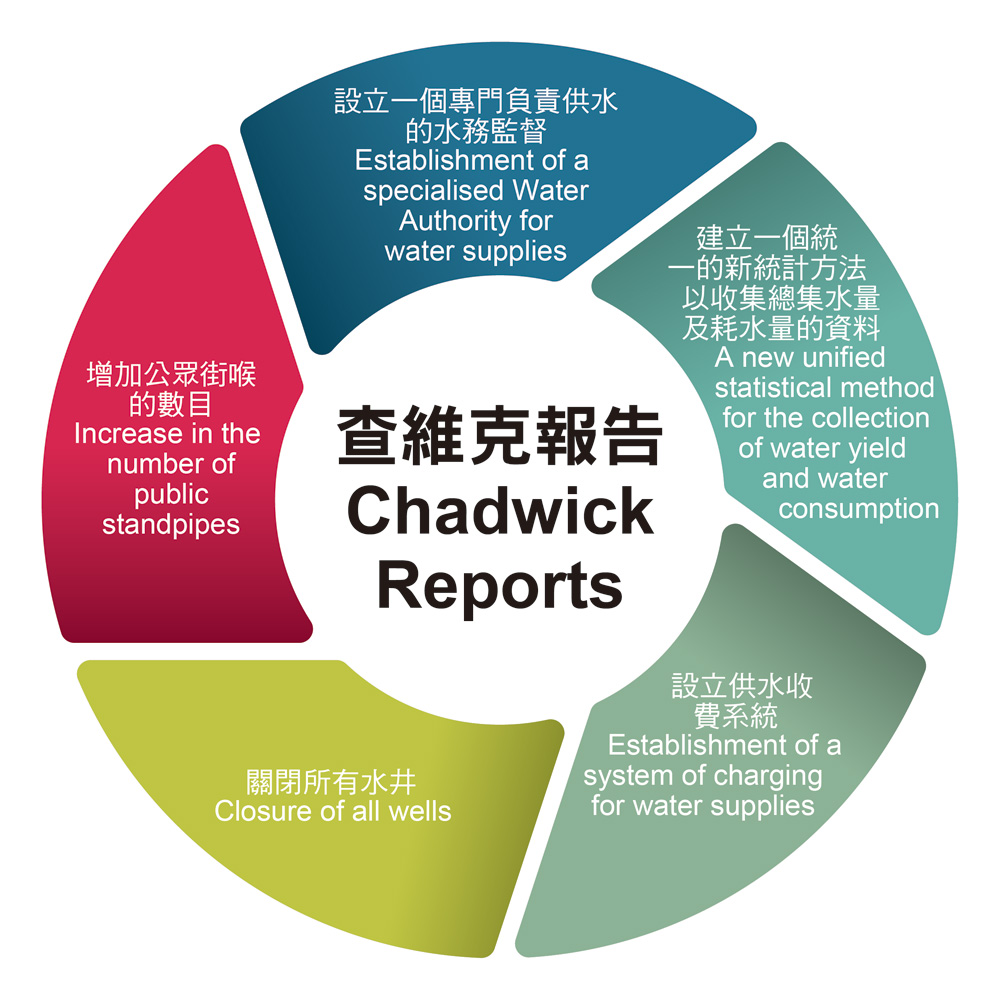
1882 and 1902
Chadwick Reports
Osbert Chadwick, a British engineer, was commissioned by the Government to study the sanitary conditions of Hong Kong. He produced a report on sanitary conditions of Hong Kong in 1882. The report indicated that the insufficiency and poor condition of the water supply were important contributing factors in shortening the life span of the people in Hong Kong. He put forward a number of proposals to improve the water supply in Hong Kong. Unfortunately, his recommendations were not fully put into practice at the beginning. In 1890, he was invited to further investigate the general health situation in Hong Kong. He found that matters were deteriorating. He was concerned about the shortage of water and the contamination of the drinking water.
Very soon after the Chadwick Report 1890 was released, a plague broke out, and the problems he raised came to light. The plague in 1894 and 1896 killed thousands of people. Consequently, Chadwick’s suggestions for a better and more efficient water supply attracted serious attention from the Government. He produced another report in 1902. His recommendations formed the basis of administrative reform that set the direction for 20th century water supply services, including:
- Establishment of a specialised Water Authority for water supplies
- A new unified statistical method for the collection of water yield and water consumption
- Establishment of a system of charging of water supplies
- Closure of all wells
- Increase in the number of public standpipes
Do you know?
Before Hong Kong’s public water supply system was established, most of residents used water coolies to fetch or buy their supplies of water from wells or streams. In 1882, 10 gallons of water cost between 4 cents and 10 cents. This water was more expensive than the charge for metered water subsequently implemented. The charged metered supply system also gave access to more hygienic and convenient supplies than the public standpipes that were often used.
1897
Introduction of Meters and Charges System in Kowloon
The Kowloon Peninsula became British Colony in 1860. However, the area was only sparsely populated in the early years. In 1895, the first water supply system for Kowloon was completed, signifying the beginning of Kowloon’s urbanisation. An important part of the system was a pumping station at Yau Ma Tei. Part of the pumping station can still be found today at 344 Shanghai Street, which has been preserved as a Grade I historic building.
The Kowloon Waterworks, as it was known, also heralded the introduction of water meters to gauge the amount of water used by individual households and commercial premises. Daily water consumption in each household was limited to 15 gallons (68 litres) per person. Consumption was charged at a rate of 25 cents for every 1,000 gallons (4.5 m3) used. A regulation concerning the use of water meters in the collection of charges was passed in 1897. It was the foundation of the water tariff system in place today.
1902
Enforcing Meters and Charges System across the Territory
Following the recommendations in the 1902 Chadwick Report, the Government passed new regulations in 1902 and 1903 to authorise the installation of water meters across the territory and a ‘user-pays’ principle was enforced.
The moves were not welcomed by the public, particularly by the merchants on Hong Kong Island who, unlike their Kowloon counterparts, had all along been enjoying water free of charge. Many private users installed illegal connections to the public mains to avoid paying the charges. There was a fierce debate in the Legislative Council. In 1903, the Government announced that private users would be exempted from paying for the first 2,000 gallons (9 m3) in every 3-month period*. A rate of 50 cents was charged for every 1,000 gallons (4.5 m3) exceeding this amount and the rent for the meter itself varied from $1 to $11, depending on the size of the connecting pipe and the flow rate required.
* A free allowance of the first 12 m3 in every 4-month period is still applicable today. For details, please visit Price of Water – Water Tariff Structure in Hong Kong.