Milestones of Water Supply in 1910 - 1932

Kowloon Byewash Reservoir after completion
1910
First Reservoir Built in Kowloon
In 1898, Britain having leased the New Territories from China, the Government began to search for a site to construct a reservoir for the growing population of the Kowloon Peninsula. The then Public Works Department undertook a topographical survey across Kowloon and located the site for a new reservoir – Kowloon Reservoir. Work began in 1901 and included the construction of a dam, filter beds and a water pipe that connected the proposed reservoir with the Yau Ma Tei Pumping Station. The project was completed in 1910. The reservoir had a storage capacity of 354 million gallons (1.6 million m3), a catchment area of 438 acres (177 hectares) and the system could supply the public with 750,000 gallons (3,400 m3) of water daily. The construction of the Kowloon Reservoir changed the way in which water was supplied to the Kowloon Peninsula. Rainwater stored in the reservoir replaced well water and subterranean water pumped out by the Yau Ma Tei Pumping Station.
The reservoir system was expanded several times. The final system now known as the Kowloon group of reservoirs consists of four reservoirs which are Kowloon Reservoir, Kowloon Byewash Reservoir, Kowloon Reception Reservoir and Shek Lei Pui Reservoir, with a total capacity of 2,873,000 m3.
1929
The First Severe Drought
Hong Kong went through one of its severest droughts in 1929. For details, please visit Climate Change in Hong Kong – Drought in Hong Kong.
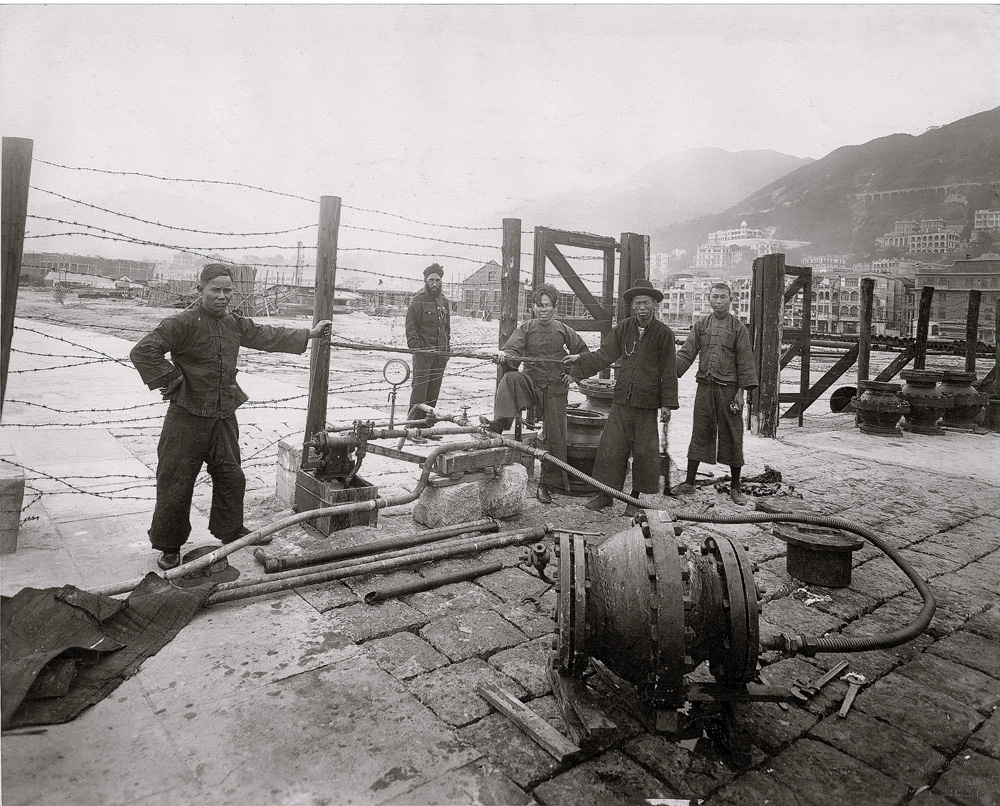
Workers carried out the pressure testing
of the first submarine pipeline
1930
First Cross-Harbour Pipeline
The water resources on the Hong Kong Island had been fully exhausted. It was necessary to look for supply from the other side of the harbour.
The idea of connecting Hong Kong and Kowloon by a cross-harbour pipeline to relieve water shortages on Hong Kong Island was discussed as early as 1922. However, it was not until March 1930 that the first submarine pipeline was completed. In those days, laying of nearly 6,000 ft (1,830 m) length of pipeline with a diameter of 12 inches (300 mm) along the seabed was an engineering challenge but the work was completed within an amazing 57 days.
1932
Completion of Phase I of the Shing Mun Reservoir
The search for additional water resources to meet the growing demand continued. Construction of the Shing Mun Reservoir started before the 1929 drought. Phase I of the Shing Mun Reservoir was completed in 1932. It had a dam measuring 400 ft (122 m) wide and 115 ft (35 m) high, with a storage capacity of 900 million gallons (4.1 million m3). Phase II included the construction of the Kowloon Reception Reservoir and the Shek Lei Pui Water Treatment Works. Upon completion of Phase III, the height of the dam was increased to 275 ft (84 m) and the capacity was more than tripled to 3 billion gallons (13.6 million m3). It was the highest dam of the British Empire at that time. To celebrate King George V’s silver jubilee of coronation, the reservoir was re-named the Jubilee Reservoir. However, Hong Kong people still prefer to call the reservoir by its old name, the Shing Mun Reservoir. With the completion of the Shing Mun Reservoir, the role of the Tai Tam Scheme, which once provided 50% of the water supply on Hong Kong Island, diminished.