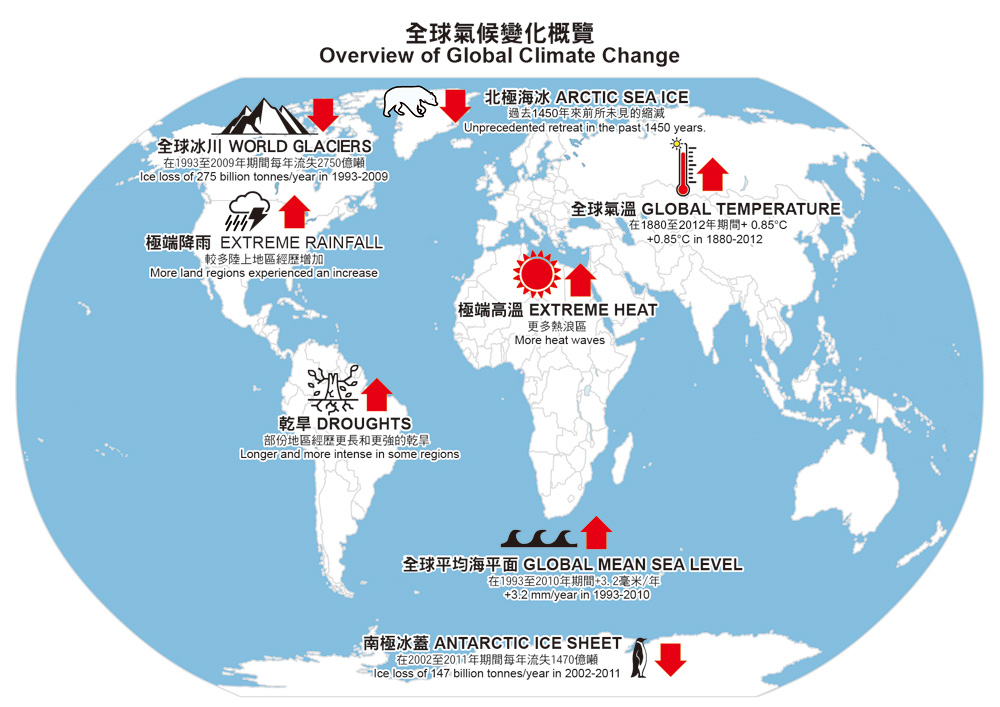
(Source: Hong Kong Observatory)
Climate change refers to the change in climate as a result of human activities that cause a change in the atmosphere’s composition, in addition to natural climate variability. Human activities cause an increase in atmospheric concentration of greenhouse gases, mainly through burning of fossil fuels which creates a broad range of global phenomena including global warming, sea level rise, melting of the glaciers and frequent extreme weather events.
(Source: Hong Kong Observatory)
Climate change leads to changes in the frequency, intensity, spatial extent, duration, and timing of extreme weather events. According to the Fifth Assessment Report of the Intergovernmental Panel on Climate Change (IPCC), the numbers of warm days and nights have increased globally since 1950 while the numbers of cold days and nights have decreased. Many land areas have experienced heat waves and heavy precipitation events since the middle of the 20th century.
Extreme weather events will be more intense and more frequent in the future.

(Source: Hong Kong Climate Change Report 2015 and Hong Kong Observatory)
In line with the global trend, Hong Kong has been warming up in the last century or so. The number of hot nights is increasing while the number of cold days is decreasing. Apart from rising temperature, Hong Kong experiences more frequent heavy rain than before. The sea level is rising in Victoria Harbour.

(Source: Hong Kong Climate Change Report 2015)
Over the last hundred years, the number of hot nights (days with a minimum temperature of 28°C or above) and very hot days (days with a maximum temperature of 33°C or above) in Hong Kong has increased while the number of cold days (days with a minimum temperature of 12°C or below) has decreased.

Changes in the annual number of hot nights, very hot days and cold days in Hong Kong
(Source: Hong Kong Observatory)
Also, extreme precipitation events have become more frequent. The hourly rainfall record at the Hong Kong Observatory Headquarters was broken several times in the last few decades, whereas it used to take several decades to break the record in the past.
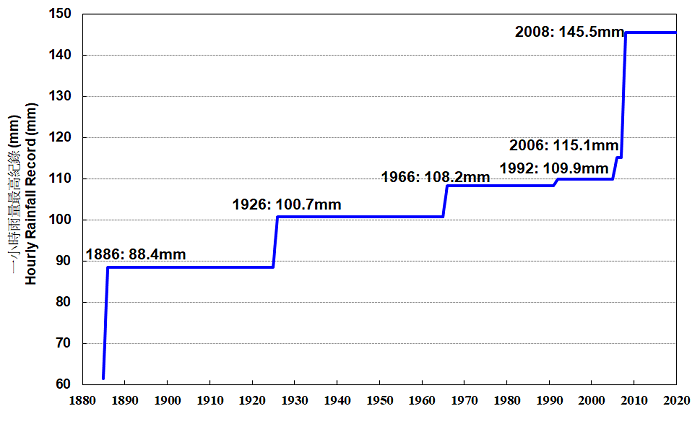
Hourly rainfall records at the Hong Kong Observatory Headquarters (1885-2020)
(Source: Hong Kong Observatory)
Hong Kong has gone through a number of severe droughts in its history. The severest ones happened in 1929 and 1963.
From October 1928 to the end of the year, there was only 32 mm of rainfall and from January to April in 1929, only another 90 mm of rainfall was recorded. The small amounts broke all previous records. The beginning of the wet season in 1929 did not help either. All reservoirs on Hong Kong Island except Tai Tam Tuk dried up.
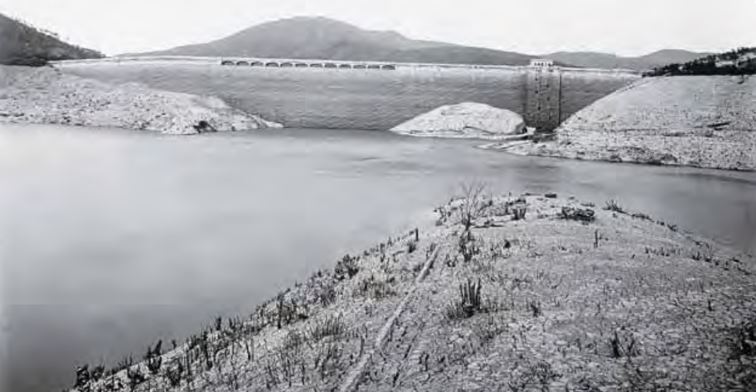
Tai Tam Tuk Reservoir was about to dry up in the drought in 1929
In April 1929, the most extreme water rationing measures were imposed. Each person was permitted to fill only two 4-gallon (18 litres) buckets from public stand pipes. During the period, the Government repaired storage pools and established new water tanks in densely populated areas to provide fresh water for the public. The Government made use of water boats to convey fresh water from Lai Chi Kok to the Western District waterfront. Water was then pumped into these tanks situated near the harbour.
On 17 June, the Government estimated that the Kowloon group of reservoirs had only 80.5 million gallons (363,000 m³) of water, just enough for 3.5 months of consumption for the territory. In an attempt to solve the shortage of drinking water, the Government imported 840,000 gallons (3,800 m³) of water from Shanghai, Fuzhou, Japan and Zhuhai. The amount might appear small but it showed the severity of the situation and how desperate the Government was.
The Government also set up pumps at various streams and rivulets to convey water to the filter beds or directly to the water tanks for use by the public. This provided for around 530,000 to 750,000 gallons (2,400 to 3,400 m3) of water per day.
The Government issued emergency regulations to empower the then Public Works Department to mobilise ships and steamers to convey and store fresh water and called on different government departments and private firms to help with water transportation. The British Air Force also experimented, though in vain, with artificial rain by dispersing chemicals in the sky above the reservoir catchment areas. In addition, the Government once again opened wells and nullahs in an attempt to solve the water shortage problems.
The 1929 drought impressed upon the Hong Kong people the importance of water for human life. The Government had to think about more long-term solutions to address the water shortage problem.
From May 1962 to April 1963, only 1,626 mm of rainfall was recorded, which was substantially less than the average annual rainfall of 2,235 mm. On 31 March 1963, the storage level of Hong Kong's reservoirs was only 51% of the total storage capacity. Unfortunately, April and May 1963 were also extremely dry. The Government was forced to exercise water rationing on 2 May 1963. Later, the restriction was further tightened to 4 hours of water supply every 4 days and remained in force for nearly a year.
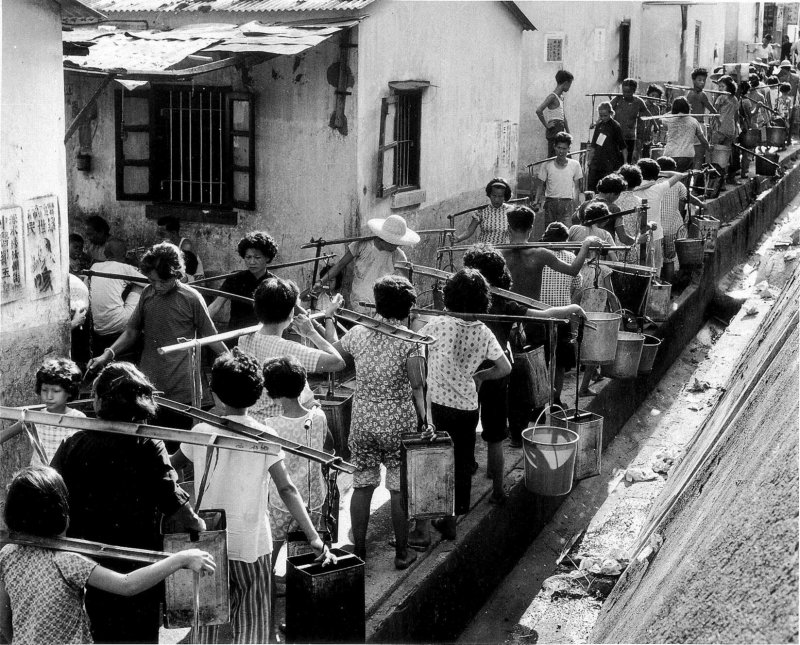
Scene of queuing for water during water rationing
During the period, the Government stopped providing facilities that required large amounts of water. Public toilets, swimming pools, and stadiums were closed. Also, the Government enacted regulations against water wastage.
From 1963 to 1964, with the permission of the Guangdong Provincial Government, water was obtained from the estuary of Pearl River and shipped to Hong Kong in tankers. In addition to the chartered tankers, other commercial ships and steamers donated distilled water produced on board the vessels, or fresh water brought from overseas. The quantity of fresh water brought in by ships visiting Hong Kong totalled 16.8 million gallons (76,340 m3). This showed that the lack of fresh water in Hong Kong had become an international concern.
Like in the 1929 drought, the Government reopened many wells. Each day these wells provided Hong Kong with 400,000 to 500,000 gallons (1,800 m3 to 2,300 m3) of water.
Until 27 May 1964, heavy rainfall brought by typhoon Viola helped put water rationing in Hong Kong to an end.
According to the records of the Hong Kong Observatory, Hong Kong experienced an exceptionally hot and dry May with a fine and near rain-free spell starting from 12 May 2018 till the end of the month. A heat wave of 15 consecutive very hot days (maximum temperature at the Hong Kong Observatory reaching 33.0℃ or above) prevailed over the territory in the latter half of the month from 17 to 31 May, by a large margin beating the previous record of 9 consecutive very hot days for May set in 1963. The monthly mean temperature of 28.3 degrees and monthly mean minimum temperature of 26.1 degrees were 2.4 degrees and 2.0 degrees above their respective normals and were the highest ever on record for May since records began in 1884. Mainly attributing to the well below normal rainfall from February to May, the total rainfall in Hong Kong from January to May 2018 was only 175.0 mm, a deficit of 73 percent compared to the normal of 640.8 millimetres and the second lowest record for the same period since records began in 1884. The scorching weather and deficient rainfall in 2018 drew comparison to the disastrous drought requiring prolonged water rationing in Hong Kong in 1963.
During the typhoon season, Hong Kong is from time to time threatened by inclement weather such as prolonged heavy rains and typhoons. Under prolonged heavy rains, there is a risk of flooding in urban and rural areas (especially in low-lying areas). In addition, strong wind and low atmospheric pressure associated with typhoons can cause sea level rising (called "storm surge") and huge waves overtopping seawall (called "overtopping wave"). When the typhoon hits, some coastal low-lying or windy places may face the risk of seawater inundation and backwater effect. As climate change goes drastic, threats induced by extreme weathers are expected to be more frequent and severe.
On 16 September 2018, severe Typhoon Mangkhut ferociously struck Hong Kong and necessitated the issuance of the Hurricane Signal No. 10 for 10 hours. This is the second longest duration of the Hurricane Signal No. 10 in Hong Kong since 1946, slightly less than the record of 11 hours set by Typhoon York in 1999. The storm-to-hurricane force winds, record-breaking storm surge and squally heavy rain brought by Mangkhut ravaged the city for about half a day, causing the most serious and extensive damage to Hong Kong since Super Typhoon Ellen in 1983.
For more videos and photos showing the impact and damages brought by Mangkhut, please browse the Hong Kong Observatory’s website:
https://www.hko.gov.hk/en/cwsrc/index_mangkhut.html
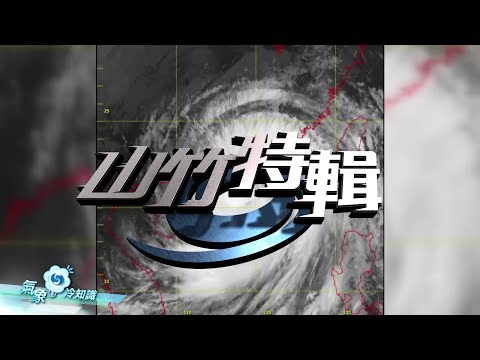
“Special Series for Mangkhut”, Hong Kong Obeservatory (broadcast in Cantonese)
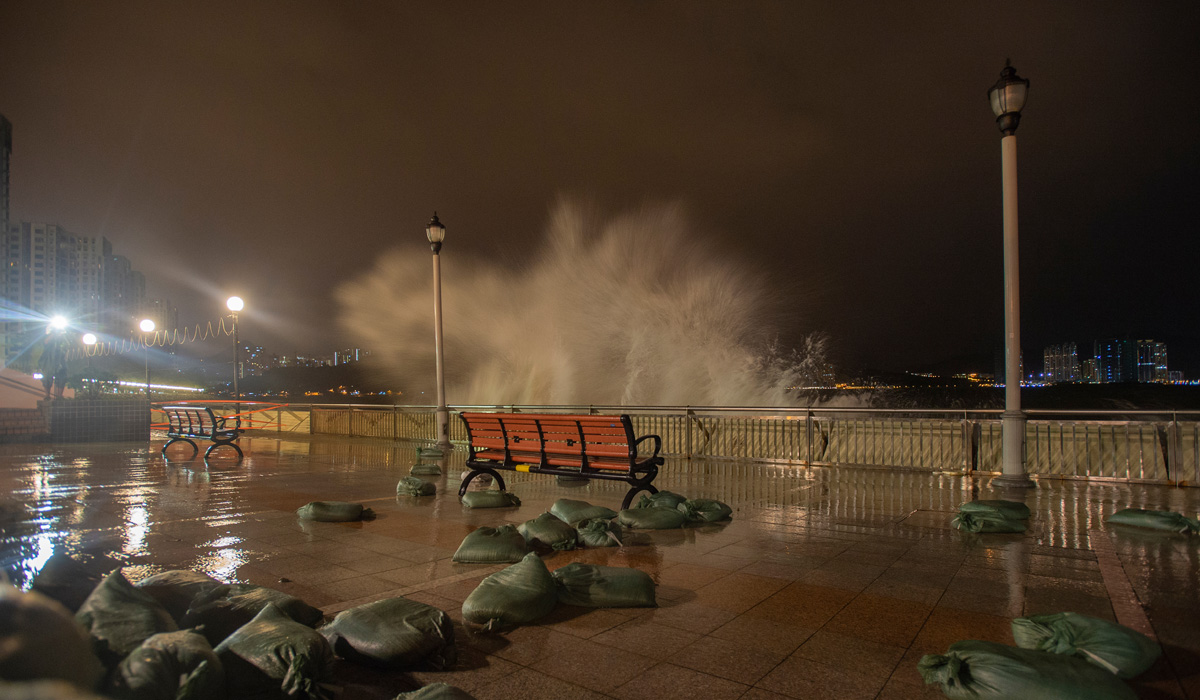
Heavy rain, storm surge and high waves caused serious flooding in many coastal and low-lying areas (Photo taken at Heng Fa Chuen; Photo source: Shutterstock.com)
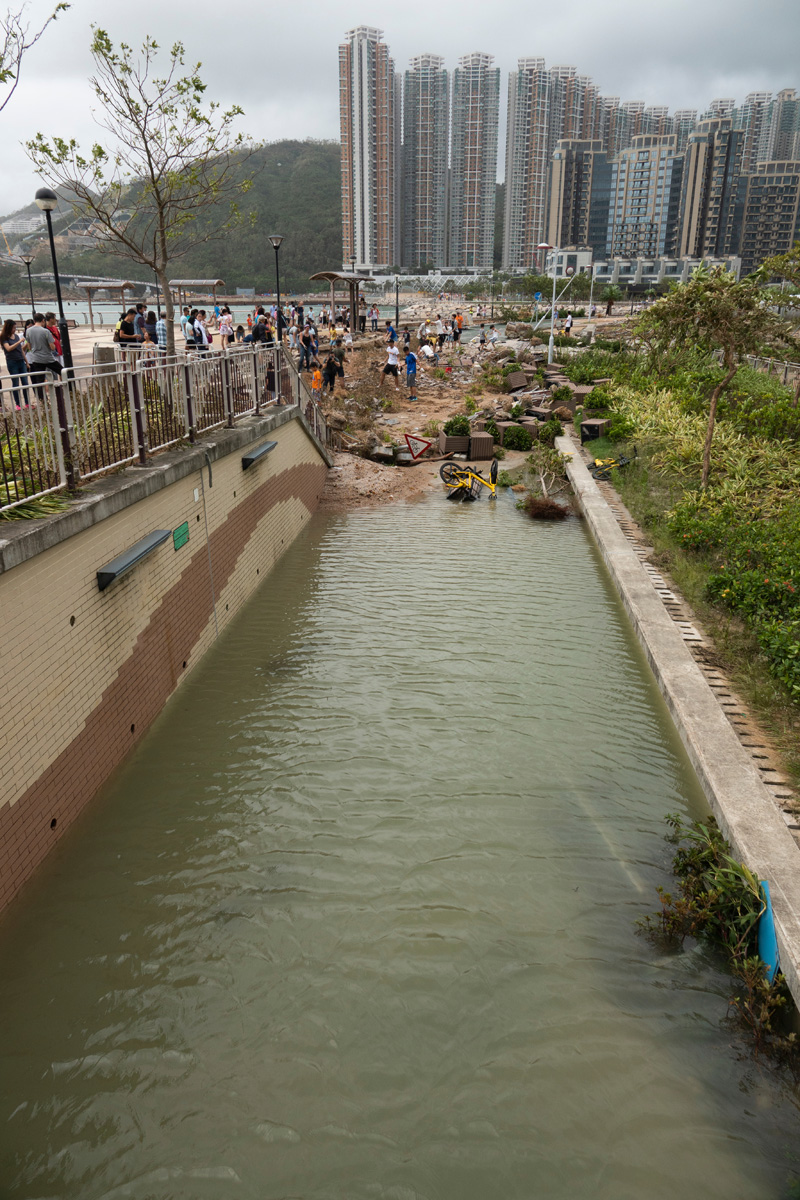
Heavy rain, storm surge and high waves caused serious flooding in many coastal and low-lying areas (Photo taken at Tseung Kwan O South; Photo source: Shutterstock.com)
In face of current challenges of population and economic growth as well as climate change, the Total Water Management Strategy has been updated in 2019 adopting a two-pronged approach with emphasis put on containing fresh water demand growth and building resilience in the fresh water supply with diversified water resources to ensure the long-term sustainability of water supply in Hong Kong.