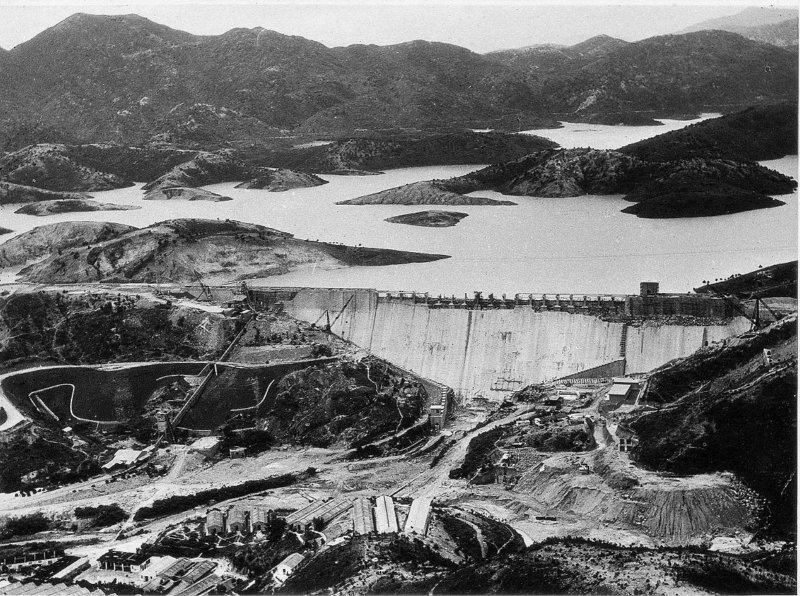
Tai Lam Chung Reservoir was the first reservoir constructed after World War II in Hong Kong
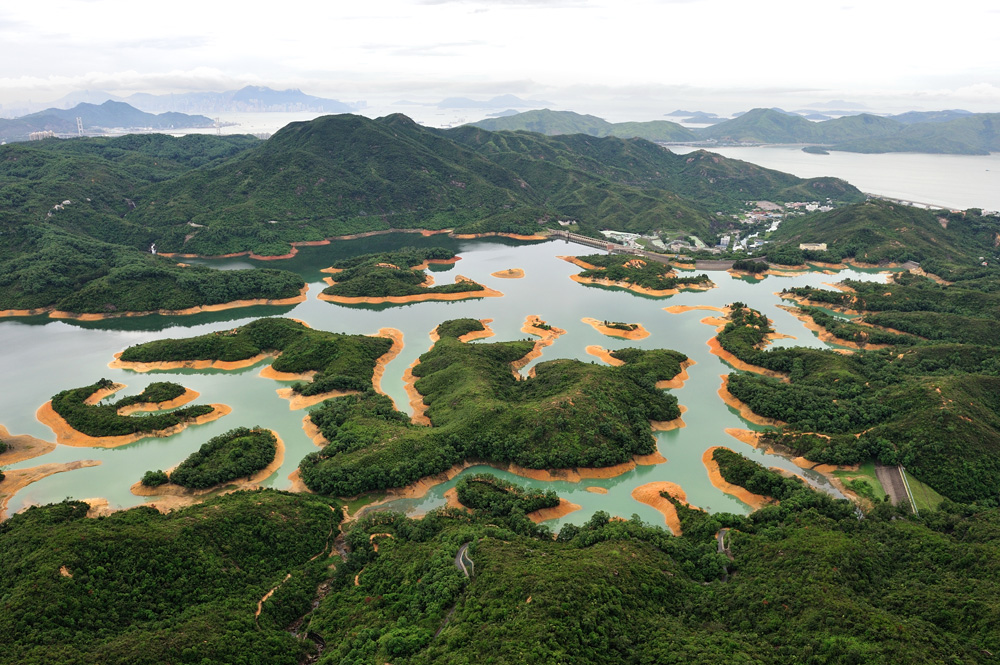
Today's Tai Lam Chung Reservoir
Before World War II, dry closets were commonly used in Hong Kong. The traditional ways of disposing human waste were not up to modern sanitation standards and were not economical. The Government attempted to abolish them as soon as possible. In the late 1950's, the use of water closets in individuals' flats was encouraged to enhance the sanitary conditions in the city.
However, the additional demand created by extensive use of flushing water would aggravate the fresh water shortage problem. In 1957, in order to save fresh water, the Water Authority suggested that it would invest $500,000 to install seawater flushing systems in the newly developed areas of Kowloon, such as Shek Kip Mei and Li Cheng Uk (resettlement areas which had a high population density). This scheme provided 400,000 gallons (1,800 m3) of seawater each day and was proved to be successful. The seawater flushing system was extended to other parts of Hong Kong.
Nowadays, the seawater supply coverage has been expanded to 85% of the Hong Kong's population. For details, please visit Seawater for Flushing.
Expansion of Hong Kong's water storage system came to a halt during World War II. The acute financial situation of the Government after the War further hampered the development of new water supply systems. It was not until 1951 that the Government embarked upon a new water project - the Tai Lam Chung Reservoir. The reservoir, completed in 1959, had a capacity of 4.5 billion gallons (20 million m3). The water from the reservoir was conveyed to the Tsuen Wan Water Treatment Works which supplies water to Hong Kong's first new town – Tsuen Wan.
Tai Lam Chung Reservoir was the first reservoir constructed after World War II in Hong Kong
Today's Tai Lam Chung Reservoir
In 1960, the Government of Guangdong Province and Hong Kong reached an agreement on importing 22.7 million m3 raw water from Shenzhen Reservoir to Hong Kong annually. For details, please visit Dongjiang Water – The History.
In 1954, the Government employed a British engineering consulting firm to survey and review Lantau’s topography, in search for an ideal place to build a reservoir. Work for the Shek Pik Reservoir and the associated scheme commenced in 1956 and was completed by 1963. The reservoir with a capacity of 5.5 billion gallons (25 million m3) was the largest reservoir in Hong Kong at that time. The catchment area measured nearly 9,000 acres (3,640 hectares). The water was treated at the Silver Mine Bay Water Treatment Works and supplied to Hong Kong Island and the neighbouring islands via submarine pipelines. This change from well water to tap water supply from the Shek Pik Reservoir assisted in modernising the life of the residents on the outlying islands.

Shek Pik Reservoir under construction
Hong Kong went through another severe drought in 1963-1964. For details, please visit Climate Change in Hong Kong – Drought in Hong Kong.
Owing to the lack of land available for building further sizeable reservoirs, in 1959 the Government began searching for a site to form a reservoir as a lake reclaimed from the sea. Such a water resource system was, in terms of planning and investment, innovative and unprecedented. The authorities chose Plover Cove, near Tai Po, in Tolo Harbour. A 1.25 mile (2 km) long dam was built across the strait, creating a man-made lake measuring 3.5 miles (5.6 km) long, 1 mile (1.6 km) wide and 2,950 acres (1,190 hectares) in surface area. The seawater would be pumped out before the lake could be used to store fresh water. The reservoir had a storage capacity of 37.3 billion gallons (170 million m3) which was 3 times the total capacity of all other reservoirs combined at the time, in 1968.
The Plover Cove Scheme was a sophisticated engineering project. Apart from the giant dam, it included the following major items of work:

The Plover Cove Scheme
Construction work started in 1961 and was completed in 1968. Fresh water coming from the Tai Mei Tuk Pumping Station of the Plover Cove Reservoir was transferred to the Sha Tin Water Treatment Works, where it was treated and then delivered through pipelines in the Lion Rock Tunnel to Kowloon and then also to Hong Kong Island.
An expansion plan for the Plover Cove Reservoir was implemented between 1970 and 1973. The treatment capacity of the Sha Tin Treatment Works was increased from 80 million gallons (364,000 m3) to 175 million gallons (796,000 m3) per day. The height of the main dam of the Plover Cove Reservoir was also raised and the storage capacity was increased to 51.7 billion gallons (230 million m3).

The first reservoir built in the sea – Plover Cove Reservoir
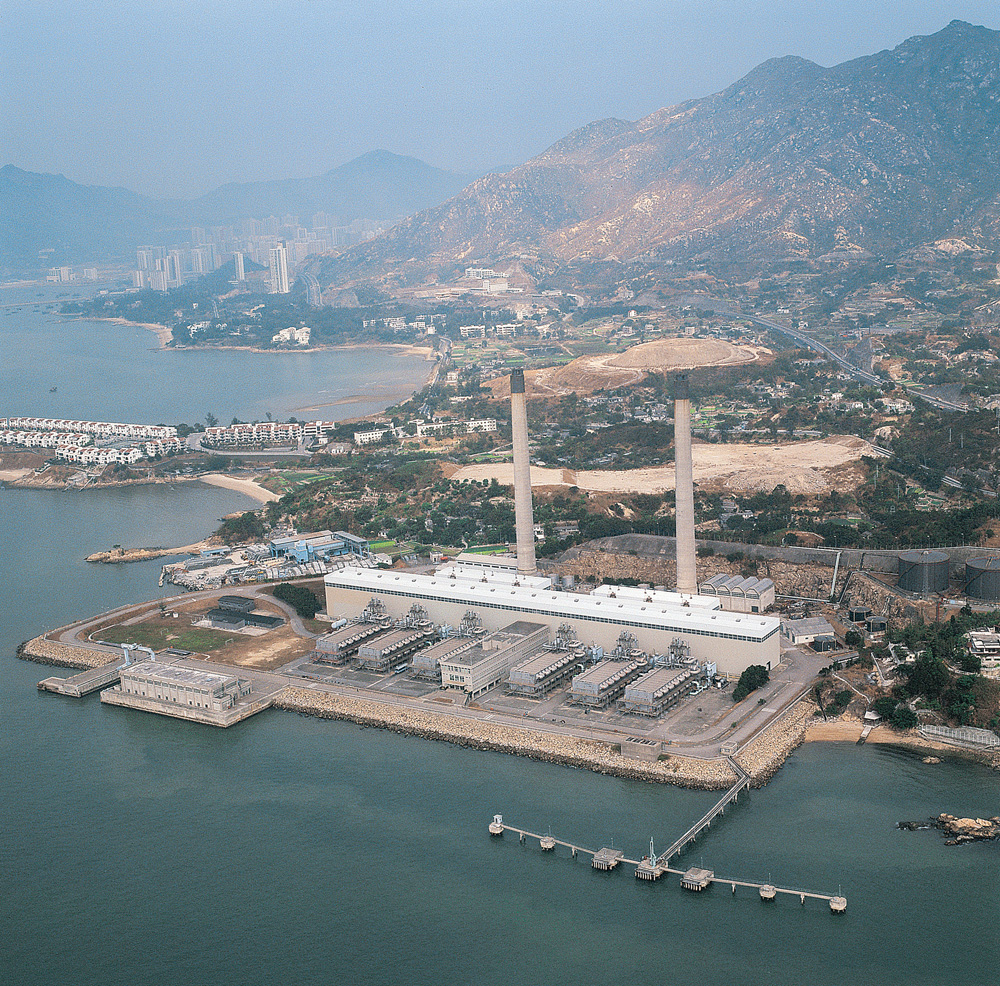
The Lok On Pai Desalter in 1970s
After the 1963 drought, the Government actively investigated the possibility of converting sea water into fresh water – a technical process named desalination. In 1970, a pilot desalination plant was built along the coast near the Tai Lam Chung Reservoir as a trial. This site was chosen because of its close proximity to the Pearl River estuary, where the sea water was relatively clear and less salty. Additionally, the desalinated water could be channelled directly to the nearby Tai Lam Chung Reservoir. In 1973 the Government, using the knowledge gained from the pilot plant, officially embarked on constructing the world’s largest desalination plant at the time – the Lok On Pai Desalter.
In October 1975, the first unit of the Desalter was commissioned. In 1977, during a severe drought, the Lok On Pai Desalter was put into full operation. Desalination was an expensive process and hence was only used intermittently to augment supply under water shortage. Hence, the usage of the plant was low. The situation worsened towards the early 1980s due to the oil crisis. In 1981, it was expected that the price of producing 1,000 gallons of fresh water would be $38 which was some 8 times higher than that of 1974. Against such an escalated cost for desalination, the Government finally closed down the Desalter in 1982.
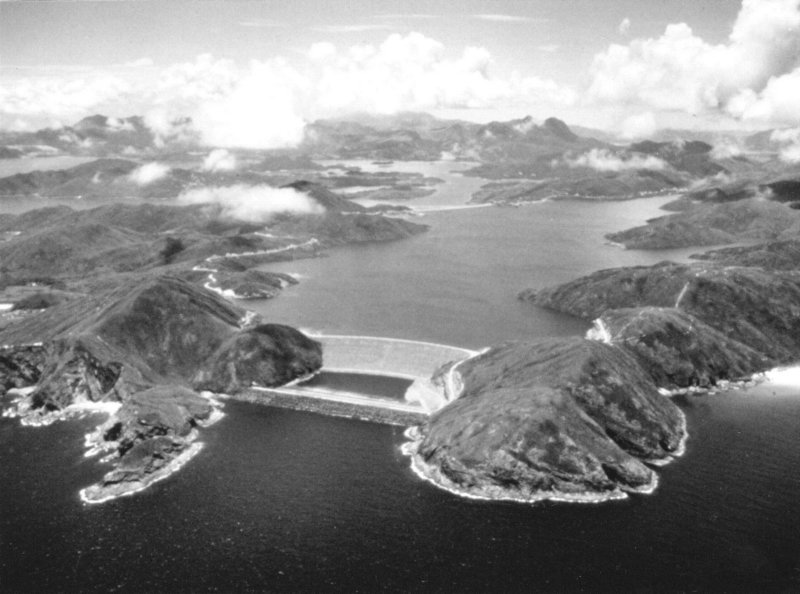
Completion of High Island Scheme
Although the storage capacity of the Plover Cove Reservoir was huge, it still could not meet the ever-increasing water demand. After the severe drought between 1963 and 1964, the Government decided to embark upon another mega waterworks project - the High Island Water Scheme. Like the Plover Cove Reservoir, the High Island Reservoir was reclaimed from the sea. It was built on the narrow strait situated between the southern part of the Sai Kung Peninsula and the High Island in Rocky Harbour. The principal engineering works included the building of 2 main dams to create an artificial lake. The seawater was then pumped out so that fresh water could be stored in the lake. The works were built between 1971 and 1978. The reservoir’s capacity of 60 billion gallons (281 million m3) is about 22% higher than that of the Plover Cove Reservoir. Upon the completion of the High Island Reservoir, Hong Kong’s total storage capacity of all reservoirs was increased to 586 million m3. The High Island Reservoir was subsequently connected with the Plover Cove Reservoir by constructing pipelines and tunnels, increasing the flexibility and efficiency of the transfer and storage of fresh water in Hong Kong.