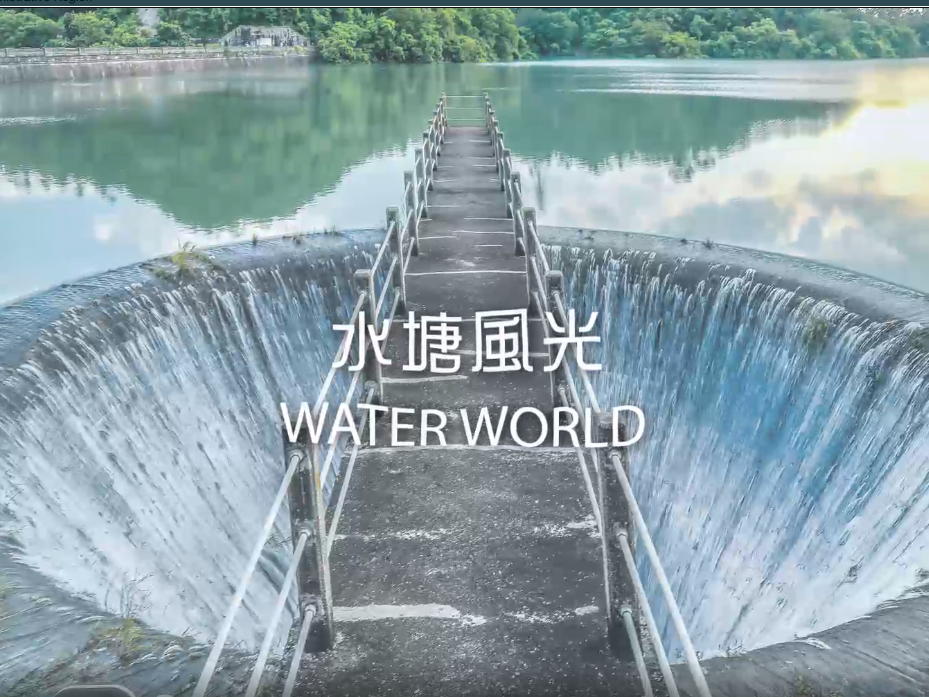
Water Gathering Grounds and Impounding Reservoirs in Hong Kong
Local yield is the rainwater collected from water gathering grounds in Hong Kong. About one third of Hong Kong's land is used as water gathering grounds where surface runoff is collected for storage. Most of these areas are also designated as part of the territory's Country Parks that are well protected from contamination.
Water Gathering Grounds and Impounding Reservoirs in Hong Kong

Annual Net Yield in Hong Kong from 2011 to 2020
Actually, the rainfall pattern in Hong Kong is unreliable, and the difference in the quantities of local yield could be up to 200 million cubic metres.
In 2020, the total fresh water consumption was 1,027 million m3. The average annual local yield is only 258 million m3, which can only satisfy about 25% of Hong Kong's need. More than 70% of the fresh water supply is imported from Dongjiang (East River) in the Guangdong Province over a long distance of more than 70 km.
There are 45 catchwater systems with a total length of about 120 km maintained by Water Supplies Department (WSD). About 57 km of these catchwaters were constructed pre-war. They are usually situated on steep natural terrain with numerous cuttings up-slope together with embankments of fill down-slope.
The total storage capacity of Hong Kong’s impounding reservoirs, comprising two reservoirs constructed by damming the sea and 15 conventional reservoirs, is 586 million m3.
| Name of Impounding Reservoirs | Capacity (Million Cubic Metre) |
|---|---|
| 1. Aberdeen Lower Reservoir | 0.486 |
| 2. Aberdeen Upper Reservoir | 0.773 |
| 3. Pok Fu Lam Reservoir | 0.233 |
| 4. Shek Pik Reservoir | 24.461 |
| 5. Tai Tam Byewash Reservoir | 0.08 |
| 6. Tai Tam Intermediate Reservoir | 0.686 |
| 7. Tai Tam Tuk Reservoir | 6.047 |
| 8. Tai Tam Upper Reservoir | 1.49 |
| 9. High Island Reservoir | 281.124 |
| 10. Kowloon Byewash Reservoir | 0.8 |
| 11. Kowloon Reception Reservoir | 0.121 |
| 12. Kowloon Reservoir | 1.578 |
| 13. Lower Shing Mun Reservoir | 4.299 |
| 14. Plover Cove Reservoir | 229.729 |
| 15. Shek Lei Pui Reservoir | 0.374 |
| 16. Shing Mun Reservoir | 13.279 |
| 17. Tai Lam Chung Reservoir | 20.49 |
| Total capacity : | 586.05 |
Capacity of reservoir means the maximum volume of water can be stored in a reservoir. If you want to know the existing storage position of reservoirs, please visit Current Storage Position of Impounding Reservoirs.
Through the game “Natural and Urban Water Cycle”, we can learn about the different forms of water and the water cycle.

Schematic Diagram of Plover Cove Water Scheme
The areas around most of the impounding reservoirs are magnificent scenic country parks open to the public for leisure and recreation purposes such as fishing (you may apply for a licence from WSD), jogging and outing.

Overflow at Tai Tam Tuk Reservoir
Overflow mainly occurs in small to medium impounding reservoirs, which were built between the end of the 19th century and the middle of the 20th century. As these reservoirs were designed to meet the water needs then, they featured relatively small storage capacities and are prone to overflow in times of persistently heavy rainstorms in the rainy season.
Under the current Dongjiang water supply agreement, the previously adopted “package deal lump sum” approach is enhanced to “package deal deductible sum” approach in which water price will be deducted according to the actual amount of Dongjiang water supplied. WSD would inform the Guangdong side the Dongjiang water supply quantity on a monthly basis, thereby achieving a better control of the storage level in Hong Kong, minimizing water overflow.
To mitigate the overflow problem, the Drainage Services Department has commenced the works contract for the "Inter-reservoirs Transfer Scheme" in February 2019, under which a tunnel connecting the Kowloon Byewash Reservoir and the Lower Shing Mun Reservoir is to be built to reduce overflow from the Kowloon Group of Reservoirs and increase water resources.
For details, please visit Inter-Reservoirs Transfer Scheme.