The Total Water Management Strategy (the Strategy) promulgated by Water Supplies Department (WSD) in 2008 has mapped out the strategy for sustainable use of water to ensure water security and support the development in Hong Kong. To safeguard the sustainability of water supplies taking account of the contemporary challenges and the latest developments on various fronts, WSD completed a review (The Review) on the Strategy in 2019.
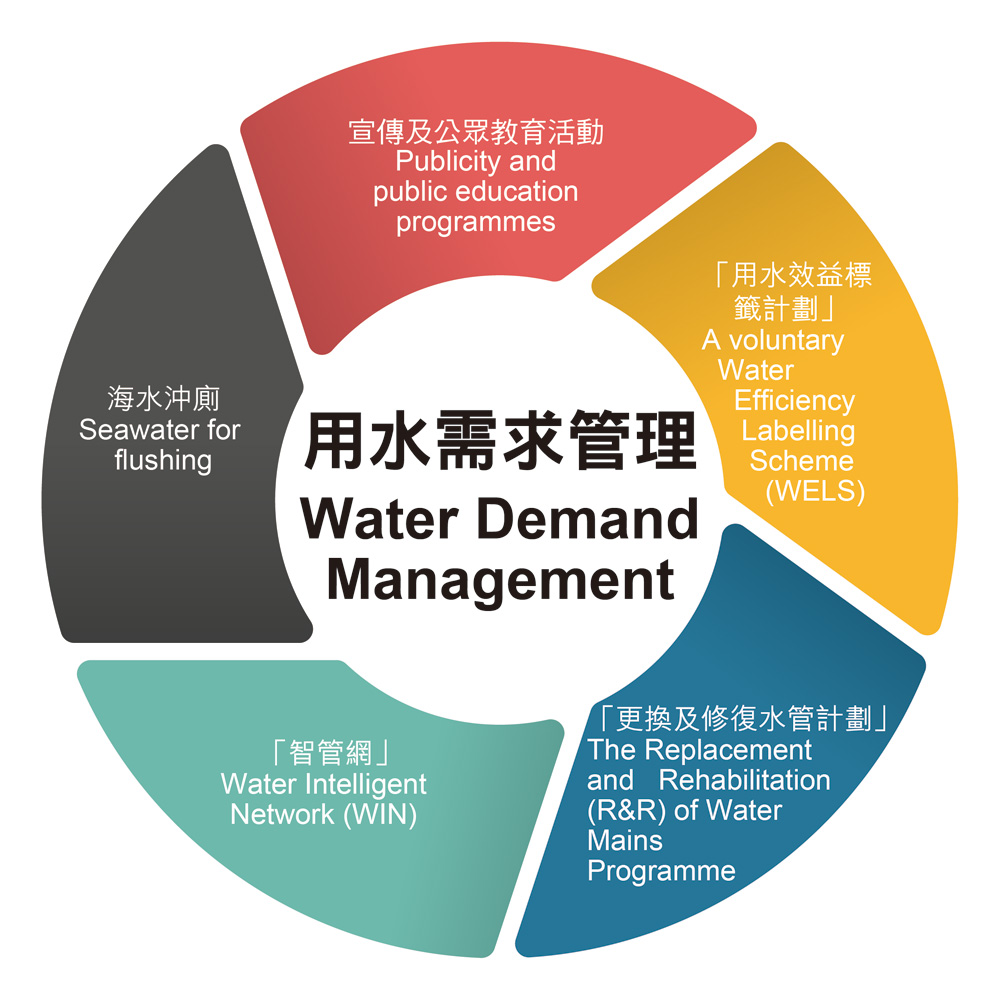
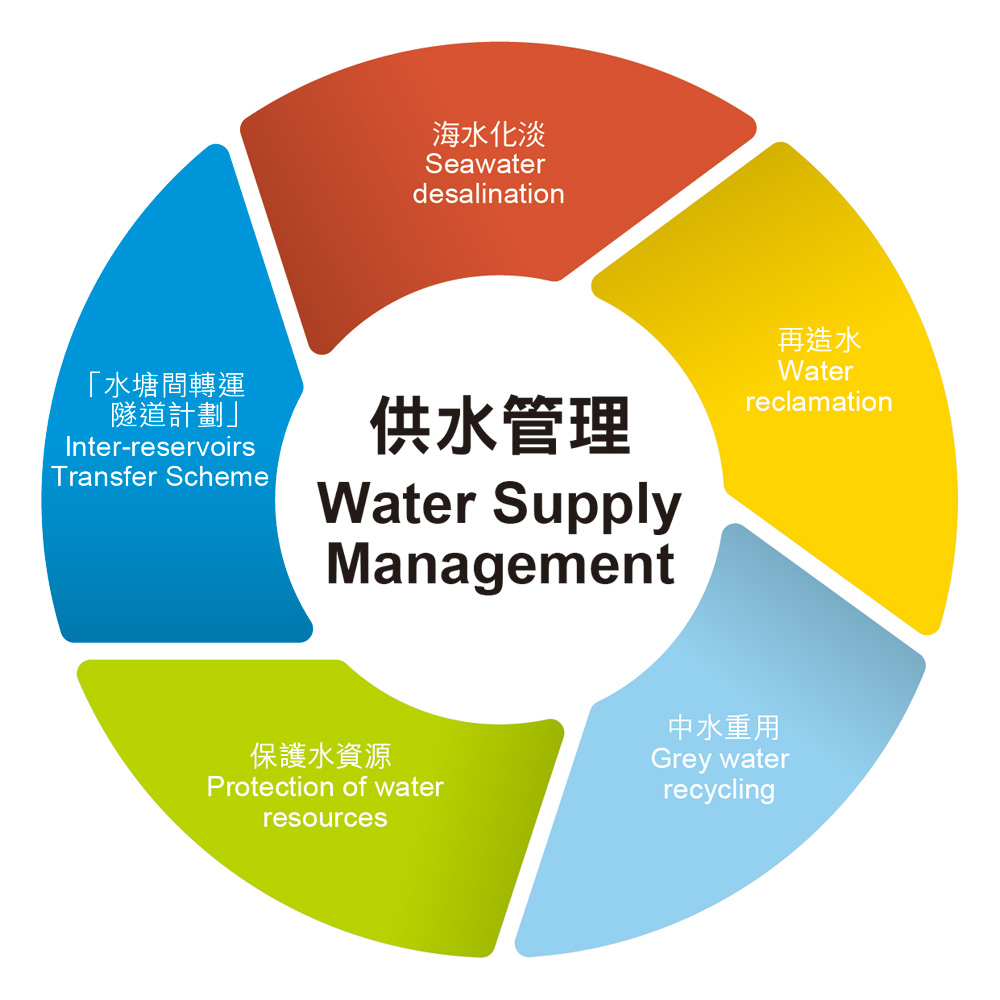
The Review confirmed that major initiatives (see the image below) in both water demand and water supply management under the Strategy have achieved their respective milestones.


Please visit Total Water Management Strategy 2019 for the details of the achievements accomplished under the Strategy.
The Review also updated the forecast of water demand and supply methodologies and projections up to 2040 taking into account impacts of climate change.
After evaluation of water management options using multiple criteria (viz. resilience, economics and sustainability), the updated Strategy (namely Strategy 2019) adopts a two-pronged approach, with emphasis on containing fresh water demand growth and building resilience in the fresh water supply with diversified water resources.
There are three main initiatives to achieve the goal, namely, (i) water conservation, (ii) water loss management and (iii) expansion of use of lower grade water for non-potable purposes.
In face of uncertainties of climate change effects on water resources, WSD is developing seawater desalination to build resilience in fresh water supply.
To improve flood protection level in West Kowloon areas and increase local yield, Inter-Reservoirs Transfer Scheme (IRTS) is implemented by the Drainage Services Department (DSD).

Water Supplies Department (WSD) has adopted a multipronged approach in promoting water conservation, using all-round measures.
The voluntary Water Efficiency Labelling Scheme (WELS) launched in September 2009 is a water conservation initiative of WSD. Products registered in WELS shall incorporate a water efficiency label that informs consumers of the level of water consumption and water efficiency in order to help consumers to choose water efficient products for water conservation. WELS covers showers for bathing, water taps, washing machines, urinal equipment, flow controllers and water closets.
The Automatic Meter Reading (AMR) System provides the metering data, status outputs and alert signals where applicable for operation and monitoring of the smart metering system. In addition to enabling automatic reading of water meters, AMR can provide customers with timely water consumption data and related information. The use of AMR can raise customers' awareness about water conservation and alert them of abnormal water consumption which may be caused by leakage in water mains inside their premises. Customers could then take early rectification action accordingly.
To raise public awareness and action about water conservation, WSD has reached out through multiple campaigns, including Let's Save 10 Litres Water Campaign, Cherish Water Campus and Cherish Water Ambassador Scheme. In late 2019, the H2OPE Centre (H2O Public Education Centre) was opened, which provides students and the general public with information about water conservation.
Furthermore, WSD has established collaborative ties with non-government organisations and green groups in promoting water conservation through various activities such as Hong Kong Water Race.
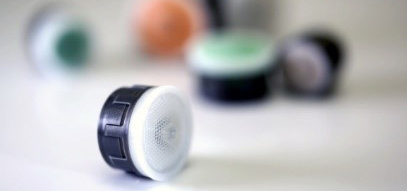
To enhance the understanding of water resources and water conservation among businesses and industries, WSD has established a series of water-saving measures, including promotion of the "Best Practice Guidelines on Water Usage" to catering and hotel sectors, installation works of water saving devices in public housing rental estates, private housing estates, government venues and schools, and distribution of free water flow controllers to the domestic households via the "Let's Save 10L Water" Campaign and application for e-Bill service.


For details, please visit Total Water Management Strategy 2019.

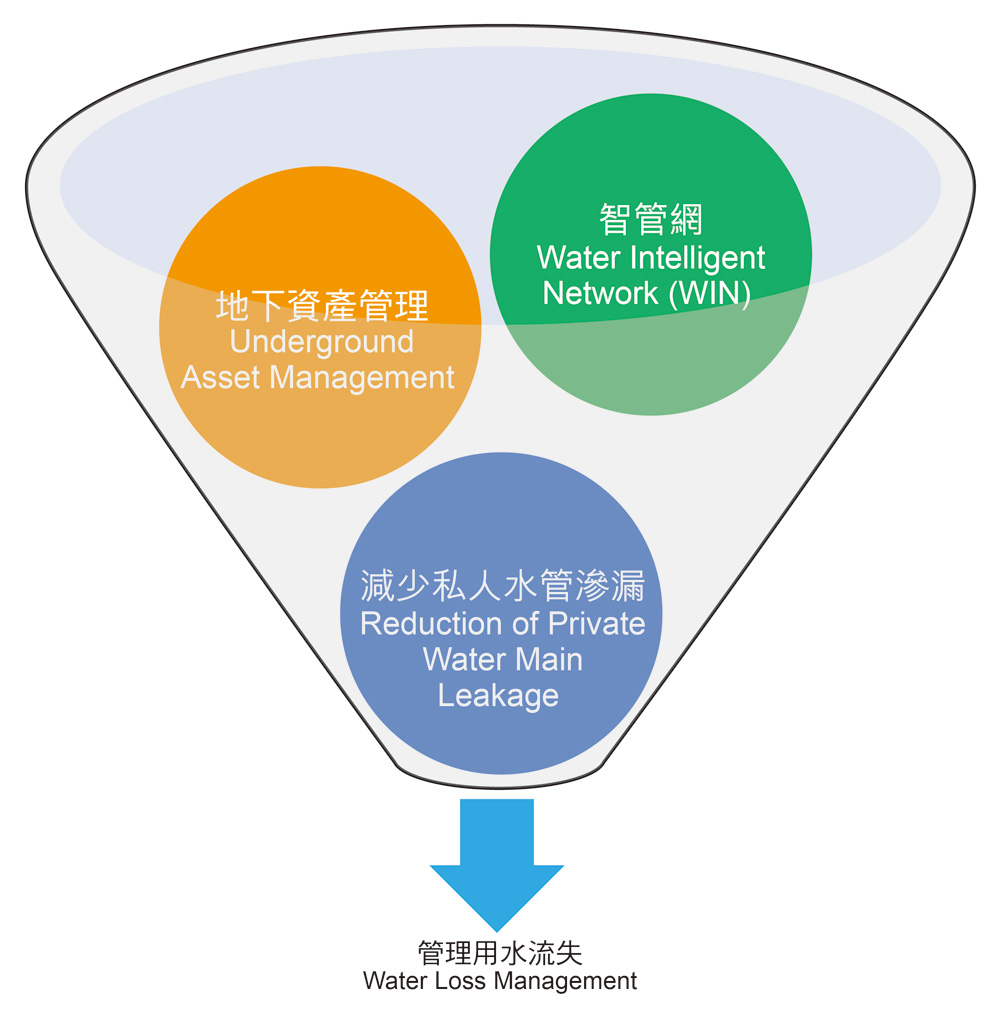
Water Supplies Department (WSD) applies an extensive range of water leak detection methods as well as a suite of district-wide monitoring and pressure management technologies to reduce water loss along the distribution system.
The essence of WIN is to divide the vast fresh water distribution network in the territory into discrete 2,400 District Metering Areas (DMAs) of manageable size for continuous monitoring of their water loss for taking effective network management actions including:
Having drawn on the international best practices, a strategy for underground asset management of water mains is implementing through an optimal balance of cost (including social cost), risk and service levels. Under the underground asset management strategy, the WSD will determine if improvement works are required for each water main in the supply network and prioritise the improvement works on a risk-based approach.
According to the Waterworks Ordinance, it is the responsibility of the registered agents (usually management companies) to repair any leakage in the communal water mains in housing courts or estates. To assist property owners and building management agents on leak detection and maintenance of water mains, WSD has been taking forward the following measures:
For details, please visit Total Water Management Strategy 2019.
Lower grade water refers to seawater and recycled water.
Seawater for flushing has been introduced in Hong Kong since the late 1950's. Up till now, Hong Kong is one of the few places extensively applying seawater for flushing. The use of such a sustainable water resource continues to play an important role in Hong Kong's water resource management.
For details, please visit Seawater for Flushing.
Water recycling is the process of additional treatment at waterworks facilities for the supply of recycled water converted from treated sewage effluent (TSE), grey water or rainwater collected outside gathering grounds. Recycled water comprises:
Recycled water is typically colourless and odourless. The common uses of recycled water throughout the world are for agricultural and landscape irrigation, industrial use and non-potable urban uses such as street cleansing, car washing and firefighting.
Reclaimed water is a water resource generated by further processing treated effluent from sewage treatment works. As reclaimed water contains a low level of nutrients (mainly nitrogen and phosphorous), it can be beneficial for plant growth and may help reduce the amount of fertilisers used in landscaping. Many countries are using reclaimed water to irrigate parks, golf courses and sports fields as well as in urban landscaping.
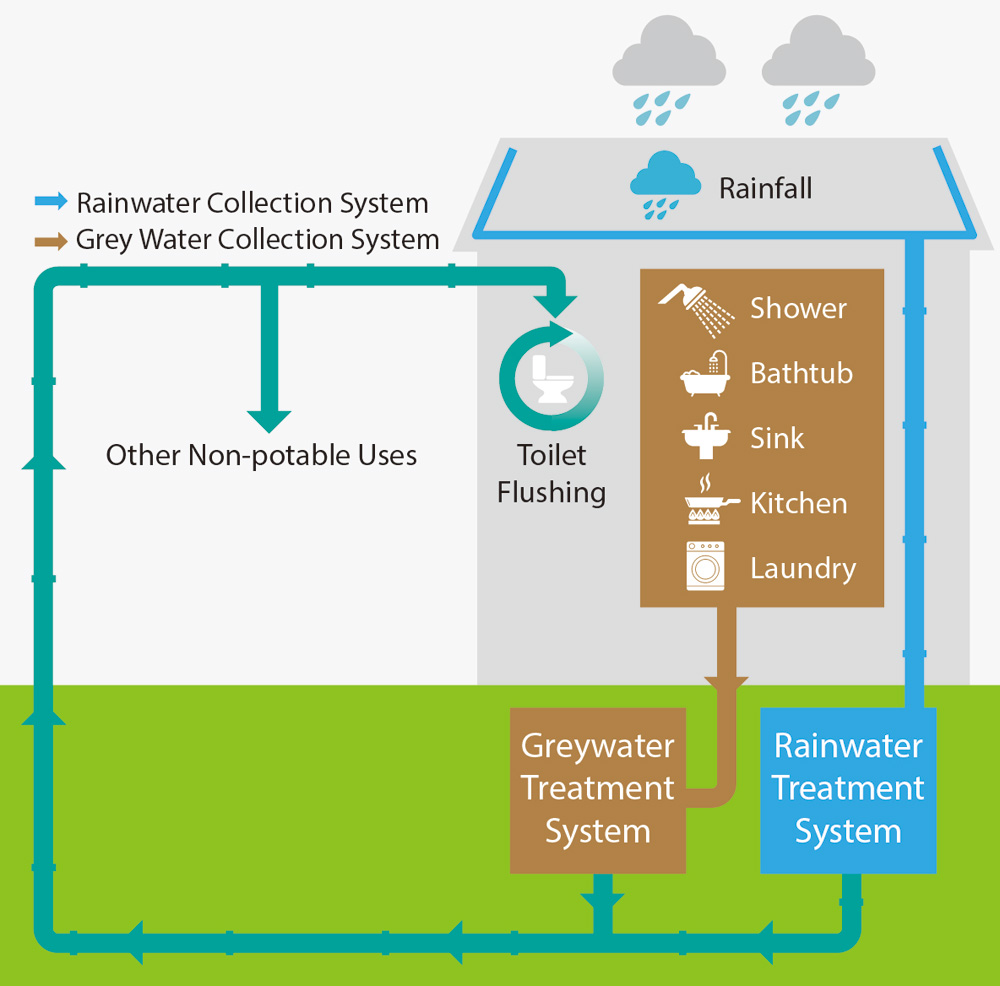
Water collected from baths, showers, wash basins, kitchen sinks and laundry machines etc. is known as grey water. Along with harvested rainwater, the grey water can be treated and reused for non-potable purposes such as toilet flushing.
| Hidden | Hidden |
|---|---|
![]() Reliability |
To better prepare for the challenges of climate change and increasing demand for fresh water due to rapid population and economic growth, and competition for water resources, many countries have been developing new water sources which are not susceptible to climate change. Recycled water is one of those water resources which are reliable, climate-resilient and economically sound. |

![]() Environmental Protection |
It is also environmentally friendly that recycling waste water decreases waste water discharges and minimises environmental impacts. |
![]() Diversified Applications |
Recycled water can be used in numerous ways and the level of treatment can vary accordingly such that specific level of water quality can be achieved depending upon the use of recycled water. For example, for non-potable uses like landscape irrigation, recycled water can go through lower level of treatment process. |
WSD has been actively exploring the use of recycled water by providing a centralized recycled water supply system for toilet flushing and other non-potable uses (e.g. landscape irrigation, street cleansing, water features, car washing, etc.) in those areas where fresh water is being used for flushing and in new development areas especially in the inland areas to contain the fresh water demand. The implementation plan of using recycled water is as follows:
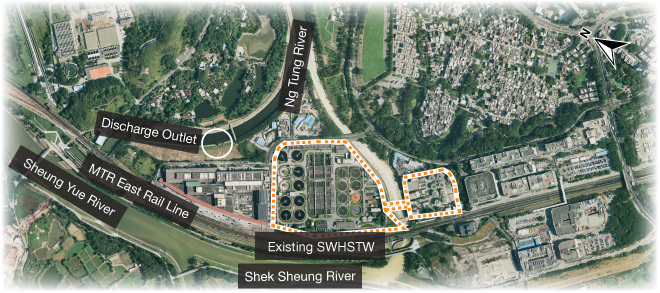
The Shek Wu Hui Sewage Treatment Works in Sheung Shui will be upgraded into an Effluent Polishing Plant (EPP) by adopting tertiary treatment. Tertiary treated effluent will be converted by further processing to reclaimed water for supply to the northeast New Territories, including Sheung Shui and Fanling currently being supplied with fresh water for flushing, for non-potable uses in phases.
The use of recycled water for non-potable purpose has been increasingly practiced throughout the world, including the United States of America, Australia and Singapore etc. The common uses of recycled water in urban areas of the United States of America and Australia are for irrigation of green areas, e.g. parks, golf courses, sports fields and greenbelts, etc., whilst recycled water in Singapore is mainly supplied for industrial uses.
At present, very few places in the world use recycled water for direct potable use because most of the people do not accept drinking recycled water. Examples of places using recycled water for direct potable use are Windhoek in Namibia and Beaufort West in South Africa etc.
There are also examples using recycled water for indirect potable use, such as Singapore where a certain amount (at about 2% to the total daily potable water consumption) of "NEWater" (i.e. recycled water converted from sewage treatment works) is injected into fresh water impounding reservoirs and the mixed water is treated by water treatment plants before supplying for potable use.

Singapore has built a diversified and sustainable water supply from four water sources known as the Four National Taps – water from local catchment, imported water, NEWater and desalinated water. In 2003, Singapore launched NEWater, the country's third National Tap.
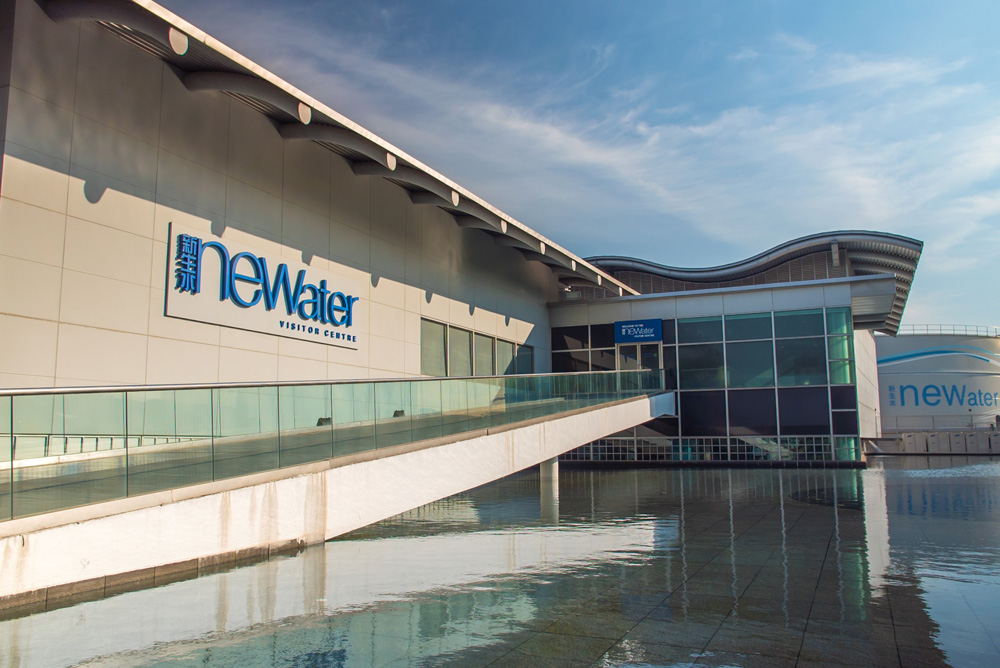
NEWater is ultra-clean high-grade recycled water produced from treated used water, with the opening of the first two NEWater plants at Bedok and Kranji. After being treated at water reclamation plant, the used water then goes through the three-stage treatment at NEWater Plants, which involves microfiltration, reverse osmosis and ultraviolet disinfection. It is mainly used for non-potable purposes in wafer fabrication parks, industrial estates and commercial buildings for cooling and industrial processes. NEWater is also used for indirect potable purposes that during dry months it is added to the reservoirs to blend with raw water, which is further treated at the waterworks before it is supplied to the consumers. Today, there are five NEWater plants in operation that contribute to Singapore's overall water needs.
(Source: PUB, Singapore's National Water Agency)
Desalination is the removal of dissolved salts and impurities from seawater, turning it into fresh water for consumption.
There are two major types of technologies for desalination, namely, membrane desalination and thermal desalination. The former technology features the use of a special filter (membrane) to produce desalinated water, whereas the latter technology involves the boiling/evaporation of seawater to give off water vapour which, on condensation, yields salt-free liquid water.
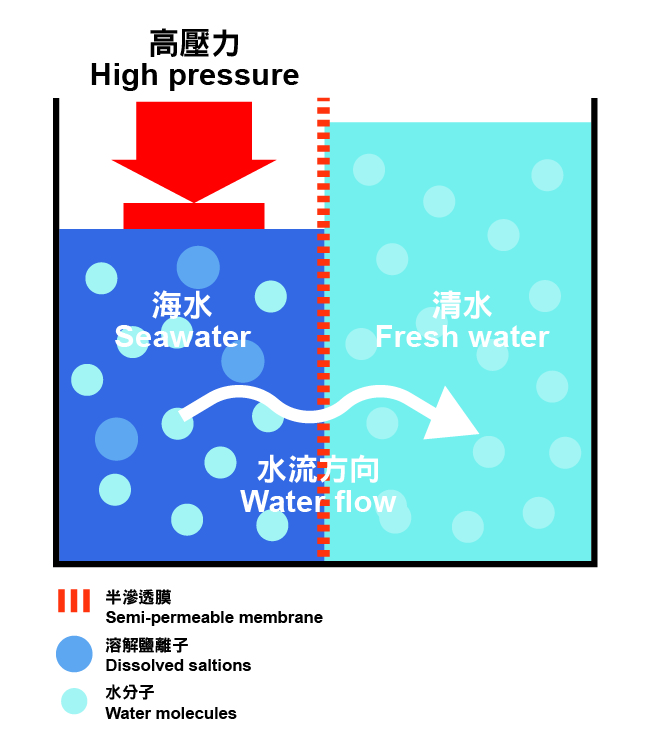
Reverse osmosis (RO), a predominant form of membrane desalination, is currently the most widely used method for desalination. RO is the process of forcing water from a more concentrated solution to a less concentrated solution through a semi-permeable membrane under high pressure. The membrane allows fresh water to pass through while it retains salts and other impurities.
For more information of other desalination technologies, please visit the website of Tseung Kwan O Desalination Plant.
Under the threats of climate change and global warming, cities around the world are facing various challenges in water supply. Seawater desalination provides a strategic water source which is less susceptible to climate change than other conventional sources of water.
Seawater, the raw material of desalination, is abundant in coastal regions. Coastal cities like Hong Kong can utilise this abundant resource to produce fresh water.
Fresh water produced by desalination is free from any impurities and readily suitable for human consumption.
(Source: Total Water Management 2019)
Seawater desalination is not something new to Hong Kong. In 1975, a desalination plant was commissioned at Lok On Pai, Tuen Mun, but it was decommissioned in 1982 due to high operation cost. For details, please visit Milestones of Water Supply in 1957 – 1978.
However, WSD has been keeping abreast of the latest developments in desalination technology. The feasibility studies in 2002 and 2007 have confirmed that seawater desalination using reverse osmosis is a viable technology to produce potable water in compliance with the Hong Kong Drinking Water Standards. Also, Reverse Osmosis process has lowest life cycle cost compared to other desalination process technologies and hence is more economically viable in comparison with other technologies.
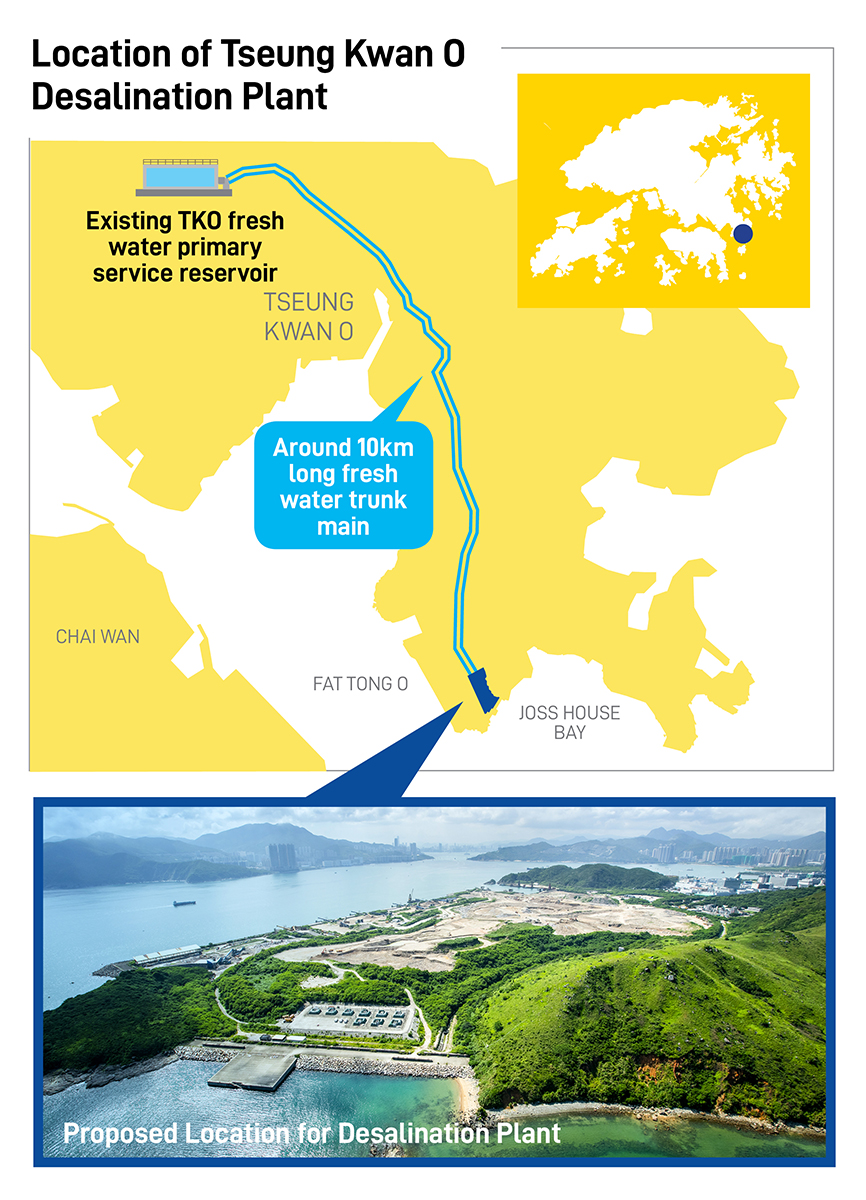
The proposed seawater desalination plant using reverse osmosis is located at Tseung Kwan O (TKO) Area 137. The plant will have a water production capacity at 135,000 cubic metres (m³) per day with provision for future expansion to the ultimate water production capacity up to 270,000 m³ per day. The first stage of the TKO desalination plant which aims to commence operation in 2023 and meet around 5% of total fresh water consumption in Hong Kong.
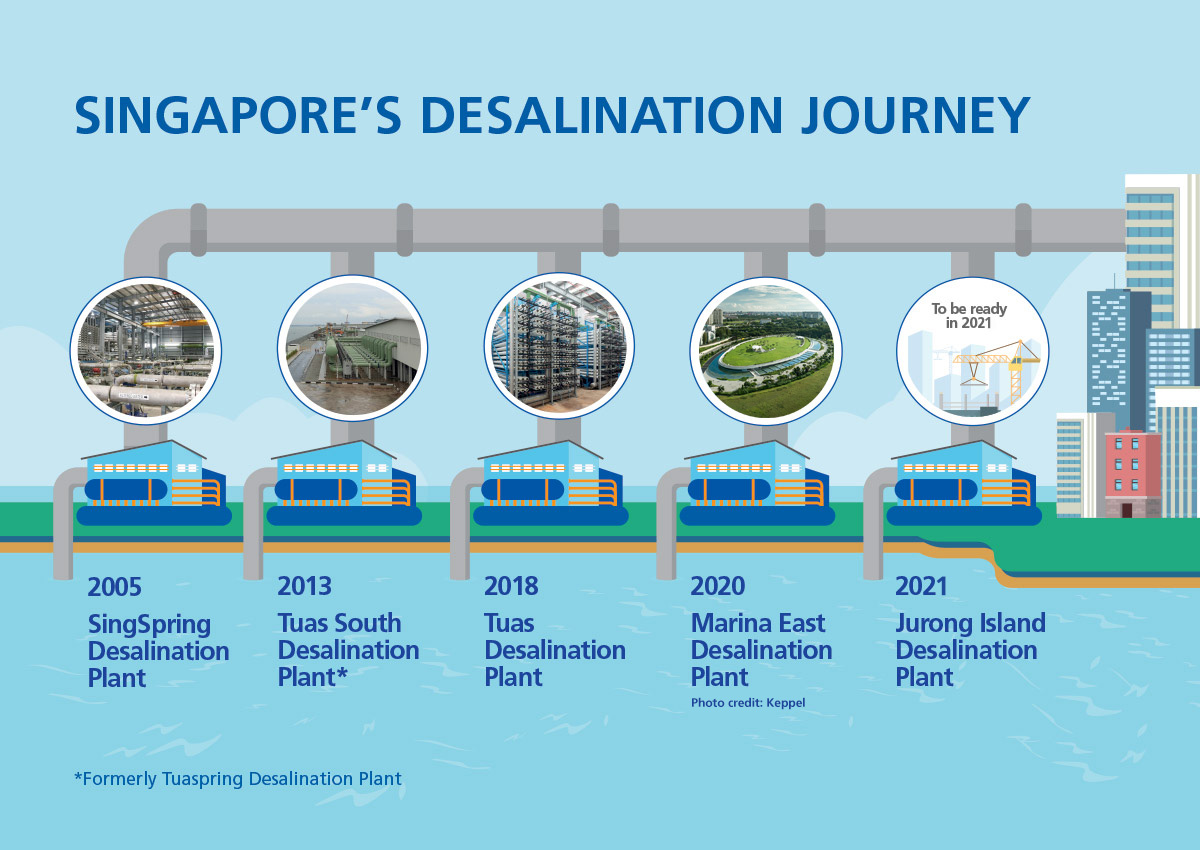
Singapore, as an island country, makes good use of its natural resource from the surrounding sea and the more advanced and economically viable membrane technology nowadays to develop seawater desalination. The country's first desalination plant began operations in 2005 as its Fourth National Tap. By the end of 2021, there will be five desalination plants that will strengthen the country's water resilience.
The Drainage Services Department (DSD) is implementing the Inter-Reservoirs Transfer Scheme (IRTS) project that builds a 2.8 km long water tunnel to connect Kowloon Byewash Reservoir and Lower Shing Mun Reservoir. The scheme serves dual purposes of reducing flood risk in Lai Chi Kok area and increasing the local yield. On one hand, it will substantially reduce the discharge of rainwater into the drainage system of Lai Chi Kok area; and on the other hand, the rainwater collected in Kowloon Byewash Reservoir can be diverted to Lower Shing Mun Reservoir to reduce overflow from the former reservoir and increase the yield of the latter reservoir. On its completion by around 2022, the IRTS is estimated to increase average local yield of around 3.4 mcm per annum, providing extra buffer of local fresh water resources.
For more information, please visit website of Drainage Services Department.
The Drainage Services Department (DSD) is implementing the Inter-Reservoirs Transfer Scheme (IRTS) project that builds a 2.8 km long water tunnel to connect Kowloon Byewash Reservoir and Lower Shing Mun Reservoir. The scheme serves dual purposes of reducing flood risk in Lai Chi Kok area and increasing the local yield. On one hand, it will substantially reduce the discharge of rainwater into the drainage system of Lai Chi Kok area; and on the other hand, the rainwater collected in Kowloon Byewash Reservoir can be diverted to Lower Shing Mun Reservoir to reduce overflow from the former reservoir and increase the yield of the latter reservoir. On its completion by around 2022, the IRTS is estimated to increase average local yield of around 3.4 mcm per annum, providing extra buffer of local fresh water resources.
For more information, please visit website of Drainage Services Department.